2026 ACCAD Open House
The 2026 ACCAD Open House features a curated selection of creative research at the intersection of arts and technology. From immersive spatial audio to full dome digital cinema and motion-capture performance, these projects represent a year of interdisciplinary collaboration. Explore the labs, meet the researchers, and experience the future of digital expression.
Full Dome Media Projects
Description
Join us in the inflatable dome for a world of immersive media developed by students in our Planetarium Media course. In this course, students blend creative vision with technical skill to design content for full-dome projection, exploring spatial visuals and immersive sound. Using Ohio State’s planetarium technologies, students learn how dome environments transform storytelling into a shared, sensory experience. The work you see here represents projects that bring science, art, and design together in creative ways.
Course: ACCAD 5194
Course Instructors:
Maria Palazzi
Professor, Design
Dr. Wayne Schlingman
Director, Arne Slettebak Planetarium
Associated Professor, Astronomy
Projects
Rainbow Flowers and Unicorn
Duration 04:00
Amarth Chen, MFA Candidate, Design
F1
Duration 03:41
Amarth Chen, MFA Candidate, Design
13 Million Galaxies
Duration 08:30
Michael Hesmond, MFA Candidate, Design
Four Seasons 사계
Duration 02:30
Geonha Kim, Communication, Design
Immersive Eye
Duration 04:00
Masha Kochanenkova, Moving-Image Production, Art Management
Canopy
Duration 03:00
Takahiro Okubo, MFA Candidate, Art
Creative Generative AI
Description
This showcase focuses on experimental projects using generative AI tools. Students explore the creative potential of AI by generating image and video, leveraging these mediums as both creative inputs and outputs. These works represent a semester of technical experimentation and creative problem-solving.
Course: ACCAD 5500
Instructor: Chris Coleman
Project Creators
Pinaki Prasad Guha Neogi
PhD Student Computer Science & Engineering
Xinxin Guo
University Fellow, Department of Arts Administration, Education and Policy
Shekar Kandaswamy
Computer Science & Engineering
Jenna Marti
MFA candidate, Art
Asher Pollock
Department of Arts Administration, Education and Policy
Mary Finney
Program 60 Student
Linda McDonald
Program 60 Student
Plotter Lab: Drawing with Code
Description
Students at ACCAD learning to do creative coding are developing custom algorithms with visual results. In addition to being on a screen, the code can drive this pen plotter to produce physical drawings, bridging the gap between digital and physical arts and design. The results are available to visitors during the open house.
Course: ACCAD 5102
Course Instructor:
Gaëtan Robillard
Assistant Professor, Design
Project Creators
Brody Hall
Design
Emily Kocur
Computer Science & Enginnering
Jenna Marti
MFA candidate, Art
Ella Neiderer
Design
Lizzy Watkins
Design
Animation Showcase
Description
Experience a curated collection of short films and technical exercises produced by students within the core animation curriculum. This showcase highlights the technical and creative progression of our artists, moving from foundational 2D motion principles to high-level, advanced 3D character pipelines and digital lighting techniques. In addition to core coursework, the gallery features independent research and student thesis projects, reflecting the diverse and sophisticated range of animation work currently being developed at ACCAD.
Course: ACCAD 5001
Course Instructor: Benny Zelkowicz
Course: ACCAD 5002
Course Instructors:
Kyoung Lee Swearingen
Liz Hejny
Course: ACCAD 5003
Course Instructor: Matthew Derksen
Course: ACCAD 5104
Course Instructor: Kyoung Lee Swearingen
Project Creators
Assignment 1
Calvin Than
AncientIndiaSFX
Harmanpreet Singh
Breakfast in Bed
Megan Azzolina
Catch
Pearl Snyder
Ethan Pangracand
Andrew Valetta
Collective Consciousness
Steven Broaddus
Dark Fantasy Castle
Arno Xue
Flight Of The Dodo
Zandro Santos
Glitchdog
Lou Crow
Joy of Feeling Sound
Arnav Roy Choudhury
Korean Language Society
Been Han
Layers In History
Yeoleum Choi
LightBit Legends Layowitt
Chinedu Ibezim
Museum of Sixth Extinction
Yeoleum Choi
Jacob Heiserman
Sebastian King
Kyrie Iswandy
On Sight
Jules Rains
Once It Moves
Wenxi Zhu
Run
Jesus Arellano
Seasons Greetings
Trey Worthen
Seeing Red
Jack Alcorn
Lou Cariello
Andrea Cleveland
Sopha Hulsman
Sugar-Free
Via Carrierot
The Ugly Duckling
Emma Burns
Untitled
Andrew Blake
Brendan Cabungcal
Wyatt Downey
Megan Li
Untitled
Ava Robinson
Zach Ball
Brett Enders
Justin Weckstein
Untitled
Courtney Voet
Grace Mears
Noelle Pride
Nin Prevedello
Untitled
Logan Tsui
Andrew Barchet
Aisyah Zulkifli
Untitled
Megan Azzolina
Owen Riley
Katie Schantz
Trey Worthen
Upon This Night
Addie Johnson
War Pigs
Jesus Arellano Avila
Connor Harper
Emily Kocur
Nicole Li
Winter Night
Sasha Chipper
Neurodiversity VR: Virtual Reality ADHD Simulation
Description
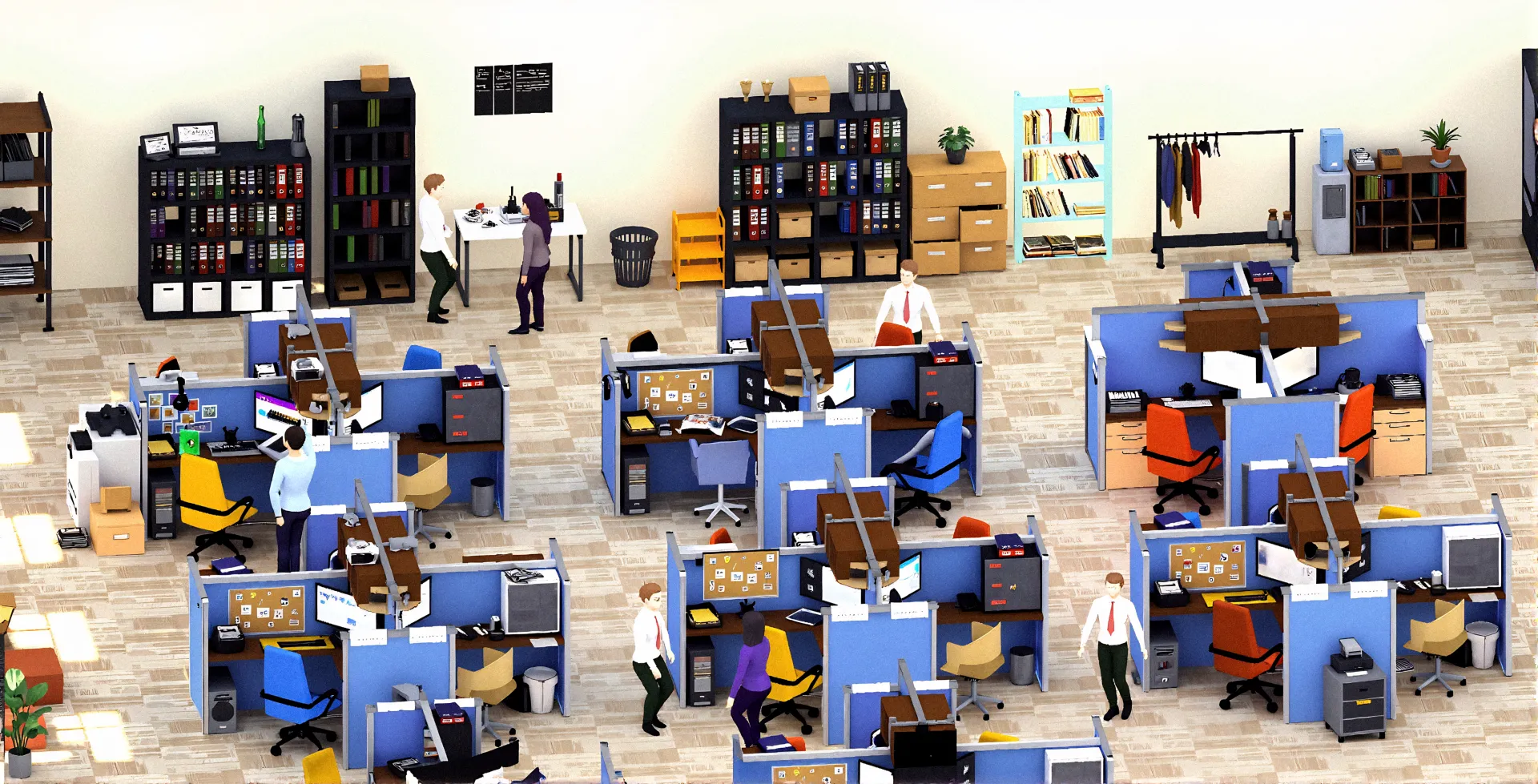
This project utilizes VR technology, putting users into virtual scenarios in which their attention and memory is challenged. Simulating offices and other work environments, the experience reflects challenges that individuals with ADHD face in workplace settings. The simulation raises awareness and ideally will foster change in a wide variety of professional workplaces.
To encourage replay-ability and produce unique experiences among individual users, this project also uses a branching narrative structure in which the user’s choices affect the outcome of scenes. Individualizing the user experience strengthens the impact of the experience.
Users will play through scenarios set in office cubicles, home offices, break rooms, and meetings, offering a wide range of examples of how ADHD affects the lives of people living with it.
Funding
- Ohio State University | College of Arts & Sciences Inspire Innovation Grant, “Inspiring Empathy and Inclusive Change for Neuro-diverse Individuals in Educational and Workplace Settings Through Immersive Technology,” Fall 2024
- Ohio State University | College of Arts & Sciences, Accelerator and Amplifier Grant, Spring 2025
Project Team
Investigators
Simone Drake, PhD, MSL, Professor, Department of English: Project PI
Shadrick Kuteh, MGD, Assistant Professor, Design | ACCAD: Project Co-PI
Writer
Trey Palmore, English
Voice Actors
Nathan Garthwaite, Art
Lauren Gessel, Art
3D Artists
Lauren Gessel
Yeoleum Choi, MFA Candidate, Design
Graphic Designer
Yeoleum Choi, MFA Candidate, Design
Developers
Skye Winters, MFA Candidate, Design
Sebastian King, MFA Candidate, Design
Roshan Ramamurthy, Computer Science and Engineering
Nathan Garthwaite, Art
Food Sciences Virtual Lab Test
Description
In collaboration with the CFAES Department of Food Science & Technology, ACCAD is investigating the nuanced creation of digital twin virtual environments to evaluate the impact of varied physical context on human taste perception. To facilitate this research, we engineered a custom computational pipeline that utilizes 3D Gaussian splatting to reconstruct high-fidelity virtual environments from standard monocular video. Participants engage with these immersive settings, which include stereoscopic video to simulate the presence of others, via a Meta Quest head-mounted display. By integrating augmented reality passthrough technology, our methodology allows participants to interact safely with physical food samples and complete empirical evaluations without disrupting their immersion in the experimental virtual context.
Project Creators
Aishwarya Badiger
Postdoctoral Researcher | Perception Research Lab
Jeremy Patterson
Sr. Graphics Researcher | ACCAD
Christopher T. Simons, Ph.D.
Associate Professor—Sensory Science
CFAES | Department of Food Science & Technology
Sandbox Gardening SIM
Description
An interactive simulation built for an MFA design thesis, exploring how to create responsive natural environments in video games.

Project Creator
Josh Antolovic
MFA Candidate, Design
Museum of Extinction | Layers in History
Description
Layers In History
An educational animation where a group of ants takes a field trip to an underground fossil museum to learn about Earth's history. The project blends rhythmic music with friendly visuals to present geological history in engaging and accessible manner.
Museum of Extinction
This virtual environment takes users through Earth’s five past mass extinctions to reflect on the Anthropocene and how human activity changes our world. Visitors can meet extinct animals from the past and explore the causes of today’s environmental crises. By blending scientific history with creative storytelling, the project helps people understand our impact on nature in a more artistic and emotional way.

Project Creator
Yeoleum Choi
MFA Candidate, Design
Virtual Field Lab
Description
This project builds on extensive work by ACCAD in virtual reality, along with a partnership with the College of Social Work. Together, the team has developed a new way of teaching social work through immersive, hands-on experiences that help students understand different perspectives and build practical skills.
The Virtual Field Lab places students in realistic situations where they experience what it’s like to seek social services. This allows them to practice facing the same kinds of challenges their future clients may encounter, helping them better understand and empathize with those they serve.
The VR simulation is currently used as part of the core curriculum for first-year Master of Social Work students at Ohio State and has also recently been shared with West Virginia University for use in its social work program.
Partial funding for this project was provided by:
Covid-19 Grant | Global Arts and Humanities Discovery Themes,
College of Arts and Sciences, The Ohio State University
Project Team
Project Co-PIs:
Maria Palazzi
Professor, Design
Dr. Lauren McInroy
Associate Professor, College of Social Work
Concept Development:
Shadrick Addy, Design / ACCAD
Vita Berezina Blackburn, ACCAD
Yang Chen, Graduate Student, Design
Catherine Hechmer, College of Social Work
Katie Klakos, College of Social Work
Maya Jenkins, Graduate Student, Design
Lauren McInroy, College of Social Work
Maria Palazzi, Design / ACCAD
Jeremy Patterson, ACCAD
Interactivity:
Shadrick Addy, Design / ACCAD
Yang Chen, Graduate Student, Design
Sruthi Ammannagari, Graduate Student,
Computer Science Engineering
Jeremy Patterson, ACCAD
Virtual Environments:
Shadrick Addy, Design / ACCAD
Mila Gajic, Graduate Student, Design
Maya Jenkins, Graduate Student, Design
Jeremy Patterson, ACCAD
Characters & Motion:
Vita Berezina Blackburn, ACCAD
Yang Chen, Graduate Student, Design
Maya Jenkins, Graduate Student, Design
Heran Zhou, Graduate Student, Design
Voice Actors:
Jake Athyall
Lillian Brown
Matt Derksen
Kylie Logan
Taylor Olsen
A Framework for Imaging System Simulation
Description
Technological advancement has made high image quality almost a given in TV/film productions. This pristine quality in turn prompted artists and cinematographers to deliberately incorporate more imperfections by using vintage lenses, chemical films, and other means to build a “vintage look”. However, computer generated images (CGI) are currently not equipped with methods to recreate these imperfect characteristics faithfully, thus experiencing difficulties to match the CGI sequences with live action footage shot with the vintage aesthetic. This thesis establishes a framework that uses physics-based simulation to faithfully recreate the image characteristics caused by the various components of an imaging system, including but not limited to a lens, an imager such as a digital sensor or chemical film, and other modifiers.
Project Creator
Amarth Chen
MFA Candidate, Design
Joy of Feeling Sound
Description
This project, Joy of Feeling Sound, explores the translation of auditory experiences into a visual language. Utilizing nonverbal animation, the work centers on the strategic use of onomatopoeia (phonetic sound-representation) and emanata (iconographic symbols denoting motion and emotion) to express vibration and energy. Through this film, I develop a visual shorthand that communicates action and affect without the need for audio, ultimately enhancing narrative engagement and deepening the audience’s sensory understanding of the medium.

Project Creator
Arnav Roy Choudhury
MFA Candidate, Design
Circle
Description
Circle is a research-driven platform from The Ohio State University designed to normalize play between differently-abled individuals. By distributing agency across players, the system fosters social interaction and cognitive development through a cohesive ecosystem of custom sensors, wearables, and cooperative gameplay.
Sensors & Human-Body Communication (HBC)
Unlike traditional touch sensors, Circle utilizes Human-Body Communication (HBC), using biological tissue as a medium to detect specific physical interactions. The system can distinguish between various touch pathways - such as identifying which players are touching—and transmits this data via Bluetooth. This allows for meaningful physical expression across a wide spectrum of abilities, supporting both active and passive participation.
Narrative-Driven Wearables
The Circle wearables bridge technical function with the steampunk-inspired narrative of Escape to Planet-9. Developed with ergonomic and anthropometric precision, these uniquely designed devices ensure comfort and safety for all users. By grounding technology in a "remote-control rescue" storyline, the wearables become immersive artifacts that spark curiosity and joy.
Cooperative Gameplay: Escape to Planet-9
Drawing inspiration from "golden age" arcade games, the gameplay is designed to accommodate varying cognitive loads. In Escape to Planet-9, players act as astronauts who must coordinate asymmetrical movements—such as navigating a robot or reversing gravity—through shared physical touch. This structure ensures that progress is achieved only through collective, synchronized action.
FUNDING:
Battelle Engineering, Technology and Human Affairs (BETHA)
Project Team
Kyoung Lee Swearingen
Associate Professor, Design / ACCAD
Scott Swearingen
Associate Professor, Design / ACCAD
Dr. Asimina Kiourti
Faculty Electrical & Computer Engineering
Dr. Jamie Boster
Nationwide Children’s Hospital
Skye Winters
MFA Candidate, Design
Rae Watters
MFA Candidate, Design
Yeoleum Choi
MFA Candidate, Design
Emma Burns
MFA Candidate, Design
Sebastian King
MFA Candidate, Design
Andrew Holton
BS Candidate, ECE
Yuxin Yan
MFA Candidate, Design
Willow Kim
BS Candidate, ECE
Dominic J. Camps
BS Candidate, Music
Catalina Munoz Arias
MFA Candidate, Design
Melika Akhteh
MFA Candidate, Design
Role Call
Description
Welcome to Role Call! In this game you play as the Stage Manager of your University's first student-run theatre program! Cast your show from the rejects of the faculty-run show, each playthrough offering the ability to choose a different group of people. Be careful though, who you choose may be what decides the fate of your newly fledged program and the students involved.
This game is being created to research designing and writing relationship systems that feel reflective of real-life and developing methods for designing stories where the player chooses who is selected for the narrative.
Project Creators
Skye Winters
MFA Candidate, Design
Rae Watters
MFA Candidate, Design
3D Computer Animation: Form, Light and Motion I
Description
Experience a behind-the-scenes look at the technical and creative workflows driving the 3D pipeline. This collection features work-in-progress from ACCAD 5002, highlighting the foundational stages of digital world-building.
From initial character modeling and structural rigging to the nuances of virtual lighting and motion studies, these excerpts offer a window into the iterative process. These projects showcase how students navigate the intersection of digital physics and cinematic storytelling to bring their first concepts to life.
Course: ACCAD 5002
Course Instructor:
Elizabeth Hejny
PhD Candidate, Design
Project creators
Calvin Than
MFA Candidate, Design
Tracy Edo
Film Studies / Video Arts
Kaylin Muyjong Kerrick
Computer Science & Engineering / Animation
Chelsea Chau Lam
Computer & Information Science / Animation
Megan Li
Computer Science & Engineering / Animation
Ty Pavia
Studio Art
Nin Prevedello
Moving Image Production
Katie Schantz
Art/Animation
Pearl Snyder
Moving Image Production / Studio Art
Logan Tsui
Moving Image Production
Gaming & Interactive Animation
Description
Explore a showcase of advanced game art and interactive animation. Featuring student-led demo that highlight networked multiplayer games and real-time 3D cinematic experiences.
Course: ACCAD 5104
Course Instructor:
Kyoung Swearingen
Associate Professor, Design / ACCAD
Course: ACCAD 6003
Course Instructor:
Scott Swearingen
Associate Professor, Design / ACCAD
Project Creators
Solid Cog
William Frasher
Silent Exposure
Chris Emrick
WIZ
Eric Zhang
New Beginnings
Zarmeen Azmat
Starship Shooter
Michael Blaess
Pocket Wizard
Maisy Friedrichsen
Space Shipping
Adriana Ezekiel
Maisy Friedrichsen
Sebastian King
Carman Ngai
Vivian Wang
Glitchdog
Lou Crow
Flippin' Out
Sabrina Abdurahim
Michael Blaess,
Aaron Cole
Chris Emrick
Adriana Ezekiel
William Frasher
Dyna-Might Explode
Logan Costa
Maisy Friedrichsen
Anton Gruzberg
Ridwan Haque
Alchemic Shot
Michael Blaess
Aaron Cole
Chris Emrick
William Frasher
Anton Gruzberg
Ridwan Haque
The Torrent
Been Han
Abandoned
Calvin Than
Silent Rain
Harmanpreet Singh
The Stage
William D. Frasher
Untitled
David Neal
AnatoMoves
Descriptions
AnatoMoves is a collaborative research project exploring innovative ways of teaching anatomy fundamentals through activity-based instruction. Traditionally anatomy is taught through a lecture format and typically relies on either static or animated illustrations, but AnatoMoves is an interactive system that allows learners to freely move their entire body to see their skeleton, muscles, and nerves in action. It utilizes AR-51, a markerless motion tracking system consisting of 8 cameras, to recognize user’s poses and retarget that movement onto an anatomically accurate 3D model.
Project Team
Project Advisors:
Vita Berezina-Blackburn
Sr. Creative Technologist, ACCAD
Dr. Derek Harmon
Department of Anatomy
Contributors:
Alize Raptou
PhD Student, Dance
Skye Winters
MFA Candidate, Design
Sophia Reeder
MFA Candidate, Design
Harmanpreet Singh
Spatial Audio Lab
Description
This showcase features spatial soundscapes for music, film, and installations, produced in ACCAD’s sonic lab using modern immersive mixing.
Course: ACCAD 5500 Immersive Sound Design
Course Instructor:
Jean-Yves Münch
Senior Lecturer
Creative Researcher
ACCAD
Project Creators
Pour Over
Chelsea Lam
Inside the Broken Voice
Rezvaneh Naebian
Speech and Noise
Breanna Langenek
Roving
Felix Lin
Rice Out the Ears
Liv Bryant
Dark Choir
Leslie Torkornoo
Animation Club
Description
The official student-run outreach organization dedicated to animation fans. The club
sponsors technical workshops, industry guest speakers, and screens original shorts,
providing a creative hub for artists at their weekly meetings.
Leadership
David Neal Jr
President
Ricky Minniti
Vice President
Stephanie Griffin
Secretary
Joshua Bohn
Treasurer